
Why You Wake Up at 3 a.m.
(and What Your Sleep Tracker Won't Show You)
Four biological reasons women over 40 wake up at almost exactly the same time every night — and why the usual fixes (melatonin, magnesium, meditation) rarely resolve the real cause.
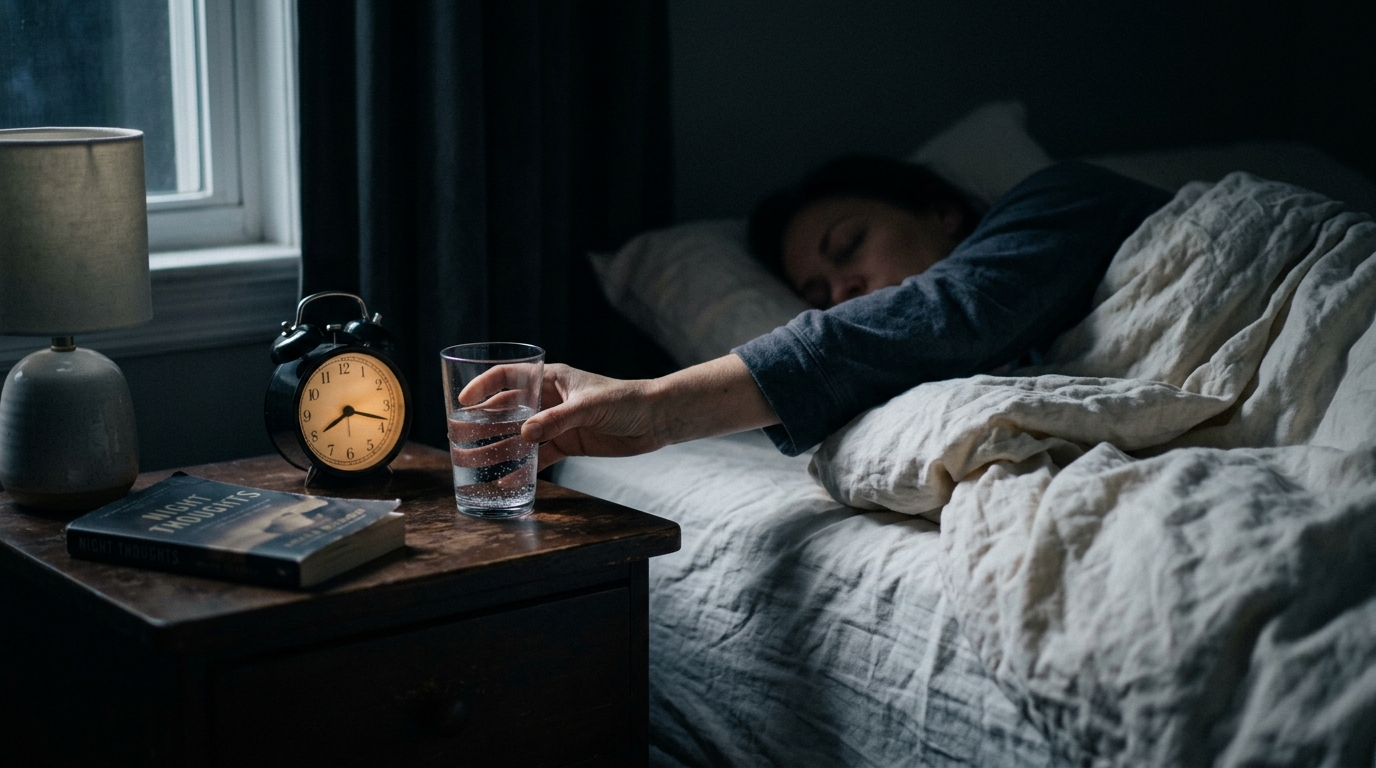

You go to bed at 10:30. You fall asleep easily. You even feel rested for the first few hours.
Then — at 2:45, or 3:10, or 3:30 — you're wide awake. Your mind is already running. You're not uncomfortable. You're not hot. You're not anxious about anything specific. You're just awake.
You try to go back to sleep. Sometimes it works. More often, it doesn't. By 5 a.m. you give up and reach for your phone, and the day starts 90 minutes before your alarm was set to go off.
If this is happening three or more nights a week, you're not broken. And you're not alone. What you're experiencing is one of the most common, most biologically-documented patterns in women over 40 — and the reasons are specific, measurable, and addressable. Here are the four main ones.
Your Cortisol Is Spiking at the Wrong Time
Cortisol has a natural daily curve. In healthy women before 40, it looks something like this: highest in the first hour after waking (the "cortisol awakening response"), gradually tapering through the day, lowest around 2–4 a.m.
That low point at 3 a.m. is the whole reason you sleep through the night. Your cortisol is supposed to be quiet then.
In many perimenopausal and postmenopausal women, this curve changes. Instead of bottoming out at 3 a.m., cortisol spikes. The spike isn't caused by stress in the psychological sense. It's a biological disruption of the HPA axis — the brain-adrenal circuit that controls cortisol release.
Your body interprets the spike as "time to wake up." Your brain comes online. You sit up in bed. You're not in danger, but your nervous system doesn't know that. This is why the 3 a.m. wake-up is almost always accompanied by immediate, sharp mental alertness — not groggy confusion. Alertness is what cortisol does.
Estrogen Is No Longer Holding the Line
For most of your adult life, estrogen has been doing quiet work in the background of your sleep architecture. Estrogen modulates serotonin production. It stabilizes body temperature during the night. It contributes to the smoothness of REM cycles. And — crucially — it acts as one of the primary brakes on the cortisol response.
As estrogen fluctuates and declines through perimenopause, those stabilizing functions degrade. Your thermoregulation becomes less precise, which is where hot flashes and night sweats come from. Your cortisol response loses one of its main counterweights.
This is why the same stressors you handled at 35 feel heavier at 45 — and why the 3 a.m. wake-up wasn't happening ten years ago even if your life was more stressful then. Your biology has changed. Not your character.
Your Blood Sugar Is Dropping Harder at Night
Women over 40 often develop mild insulin resistance — meaning the body needs more insulin to move the same amount of glucose out of the blood. This is partly a consequence of declining estrogen (estrogen supports insulin sensitivity) and partly of body composition changes.
What happens overnight in a body with early insulin resistance: blood sugar drops more sharply than it used to during the fasting window between dinner and breakfast. Your body responds to the drop by releasing cortisol and adrenaline to raise blood sugar back up — and those hormones are also alerting agents. You wake up.
This is why some women notice their 3 a.m. wake-ups got worse when they started "eating cleaner" or cutting carbs at night. Aggressive fasting windows in a perimenopausal body can backfire if you already have cortisol dysregulation.
The HPA Axis Has Lost Its Rhythm
The HPA axis (hypothalamic-pituitary-adrenal) is the brain-to-adrenal-gland feedback loop that controls cortisol. In a healthy system, it's self-regulating: cortisol rises when needed, the brain senses it, the signal to produce more cortisol stops.
Chronic stress — the kind most women in their 40s have been carrying for a decade or more, whether from career, caregiving, sleep loss, or all three at once — degrades this feedback loop. The brain becomes less sensitive to cortisol's "enough, stop now" signal. The adrenals become less responsive to the brain's "release cortisol" signal. The whole system goes out of rhythm.
The HPA axis can heal. But it doesn't heal through "trying to relax." It heals when you stop sending the chronic alert signals that dysregulated it — which, for most women, requires something that works at the adrenal level directly.
A sleep tracker is a useful tool. It is not a diagnostic tool for cortisol-driven sleep disruption.
Why Your Sleep Tracker Says Your Sleep Is "Fine"
Your Oura ring, your Apple Watch, your Whoop — they all measure sleep based primarily on heart rate variability, movement, and sometimes skin temperature.
What they don't measure: cortisol. They can't. Blood or saliva cortisol can't be measured from the wrist.
This is why women often report a contradictory experience: their sleep tracker shows "7 hours 42 minutes, 85% sleep score" and they feel wrecked. The tracker is measuring time in bed with eyes closed. It isn't measuring whether your nervous system was actually resting — which, during a cortisol-dysregulated night, it wasn't.
Why Melatonin, Magnesium, and Meditation Usually Aren't the Full Answer
Melatonin helps you fall asleep. It does essentially nothing for a 3 a.m. cortisol spike, because melatonin has mostly left your system by that point. This is why many women report that melatonin "works for the first hour but I still wake up at 3."
Magnesium can support relaxation and muscle function. It is a useful basic nutrient. But for many women over 40, the middle-of-night pattern is less about needing another sedating sleep aid and more about supporting the stress-response system that keeps switching on at the wrong hour.
Meditation and breathwork reduce acute, in-the-moment stress response. Regular practice has measurable benefits for daytime cortisol. But a meditation practice doesn't reprogram a dysregulated HPA axis in the same way that targeted adaptogens can — especially for women whose cortisol pattern has been off for years.
The more useful approach is not to force sleep harder. It is to support the normal stress response upstream, where the wake-up signal begins.
What Actually Works — The Cortisol Reset
Among the interventions most studied in peer-reviewed literature for HPA-axis support in women, one stands out for sleep-related cortisol specifically: KSM-66 ashwagandha.
In a 2019 double-blind, placebo-controlled trial published in Medicine (Baltimore), adults taking 600 mg of KSM-66 daily for 60 days showed a 27.9% reduction in serum cortisol compared to placebo, plus significantly improved sleep quality scores. A 2020 trial published in Cureus specifically on sleep found improvements in sleep latency and total sleep time in adults with chronic insomnia who took KSM-66.
KSM-66 is not a sedative. It does not knock you out. It is studied for stress and cortisol-response support, which is why it belongs in the conversation when the problem feels less like "I can't fall asleep" and more like "my body keeps switching on at 3 a.m."
Reprieve Cortisol Calm uses 600 mg KSM-66 ashwagandha, the dose used in published KSM-66 stress research, plus Vitamin D3, B6, B12, L-Arginine, Maca, Panax Ginseng, and Shatavari for everyday energy, circulation, stress-response support, and vitality.
See Reprieve Cortisol Calm →Day 9 was when I first slept through. I'd been waking up at 3:17 a.m. almost every single night for over a year. My husband noticed before I did, he said I actually looked like myself again in the morning.
Sarah M., 47, Denver, CO
Honestly thought I'd just given up on sleep for good. About 8 weeks in I realized I'd been sleeping through 3 or 4 nights a week and not even thinking about it anymore. It's still not perfect but it's such a difference.
Michelle K., 51, Nashville, TN
If Reprieve doesn't change your sleep within 60 days, return the bottle — empty or full — for a full refund. No form. No survey.
Get Reprieve Cortisol Calm →