
5 Signs Your Cortisol Is Out of Control After 40
A Yale-linked study changed what we know about perimenopausal weight gain, 3 a.m. wake-ups, and the kind of brain fog that makes you forget your own daughter's middle name. The hormone responsible isn't estrogen — and most women will never be tested for it correctly.


You've been doing everything right.
You eat cleaner at 44 than you did at 34. You walk more. You cut the wine. You went to bed earlier for six straight weeks. And you still woke up at 3:17 a.m. You still forgot your sister's birthday. You still felt your waistband leave a pink mark by 2 p.m.
Your doctor ran the labs. Everything came back "within normal range." You left the appointment feeling quietly crazy.
You're not crazy. What's happening to you has a name, it has a measurable biology, and it is not the hormone everyone keeps talking about.
This is a reported explanation of what changes for most women between 40 and 55, why the five signs below are the pattern you've been missing, and what the peer-reviewed research has found about what actually helps. If three or more of them describe you, read the rest.
You Wake at 3 a.m. and Can't Get Back to Sleep
You don't wake up because you have to use the bathroom. You don't wake up because the dog moved. You wake up because your body decides — at almost exactly the same time, three or four nights a week — that it is time to be alert.
Often it's between 2:30 and 3:30 a.m. You open your eyes and your brain is already running. The meeting tomorrow. The school form. Something you said two days ago that you're not sure landed right. You try the breathing. You try the app. Eventually you reach for your phone and the blue light finishes what your cortisol started.
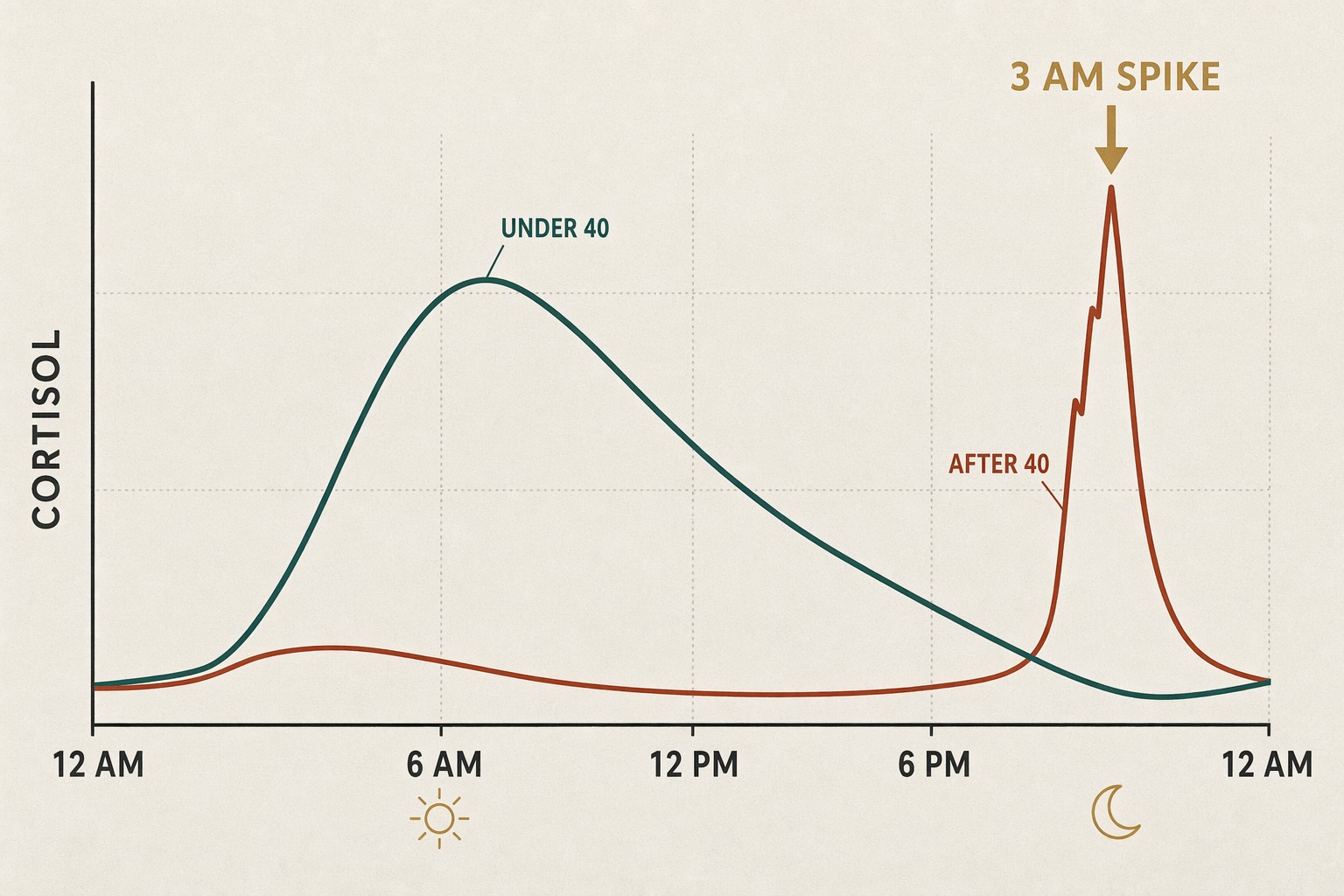
What the research shows In healthy premenopausal women, cortisol follows a predictable curve — highest in the morning, gradually tapering, lowest around 2–4 a.m. In perimenopausal women, that curve can invert. Instead of bottoming out at 3 a.m., cortisol spikes. Your nervous system experiences this as a threat signal — even when no threat is there.
What it means The 3 a.m. wake-up isn't insomnia in the traditional sense. It's a cortisol rhythm problem. This is why melatonin often doesn't fix it. Melatonin addresses sleep onset, not a 3 a.m. cortisol surge.
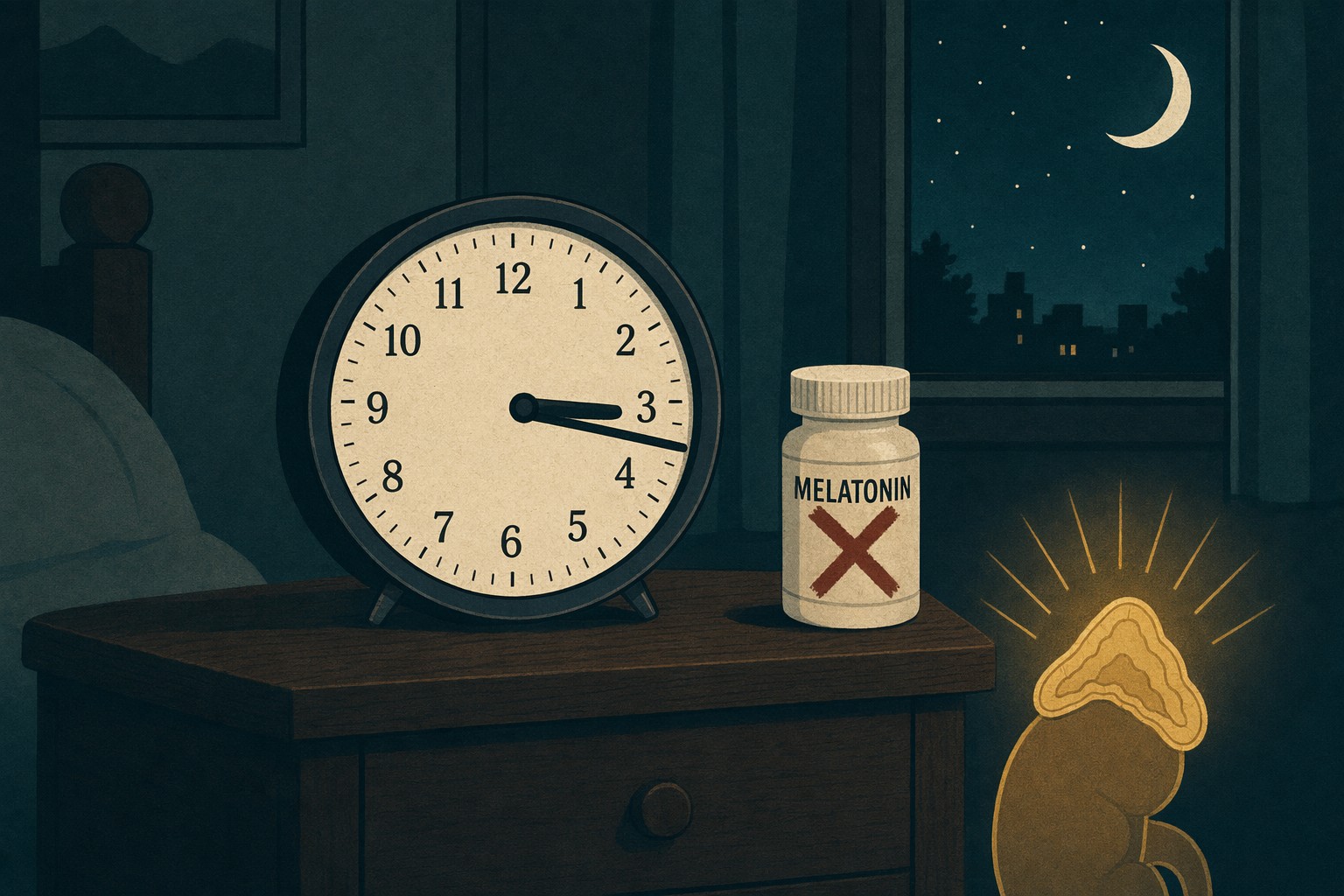
Melatonin addresses when you fall asleep. It does nothing to the biology that wakes you up four hours later. That is a different hormone on a different clock.
The Belly That Didn't Come From Your Calories
You've been eating cleaner at 44 than you did at 34. You walk more. You've cut back on wine. And yet your jeans are leaving a pink mark on your waist by 2 p.m.
You weigh yourself and the number hasn't moved dramatically. What's changed is where your body is putting the weight. It's all in the middle now. Not the hips. Not the thighs. The belly.
What the research shows Abdominal fat — specifically visceral fat, the kind that sits around your organs — contains roughly four times more cortisol receptors than fat elsewhere in the body. When cortisol is chronically elevated, your body receives a biological instruction to store fat preferentially in this area.
What it means This is not a calorie problem. It's a signaling problem. Eating 200 fewer calories a day won't fix it if cortisol is telling your body to store fat in the belly regardless.
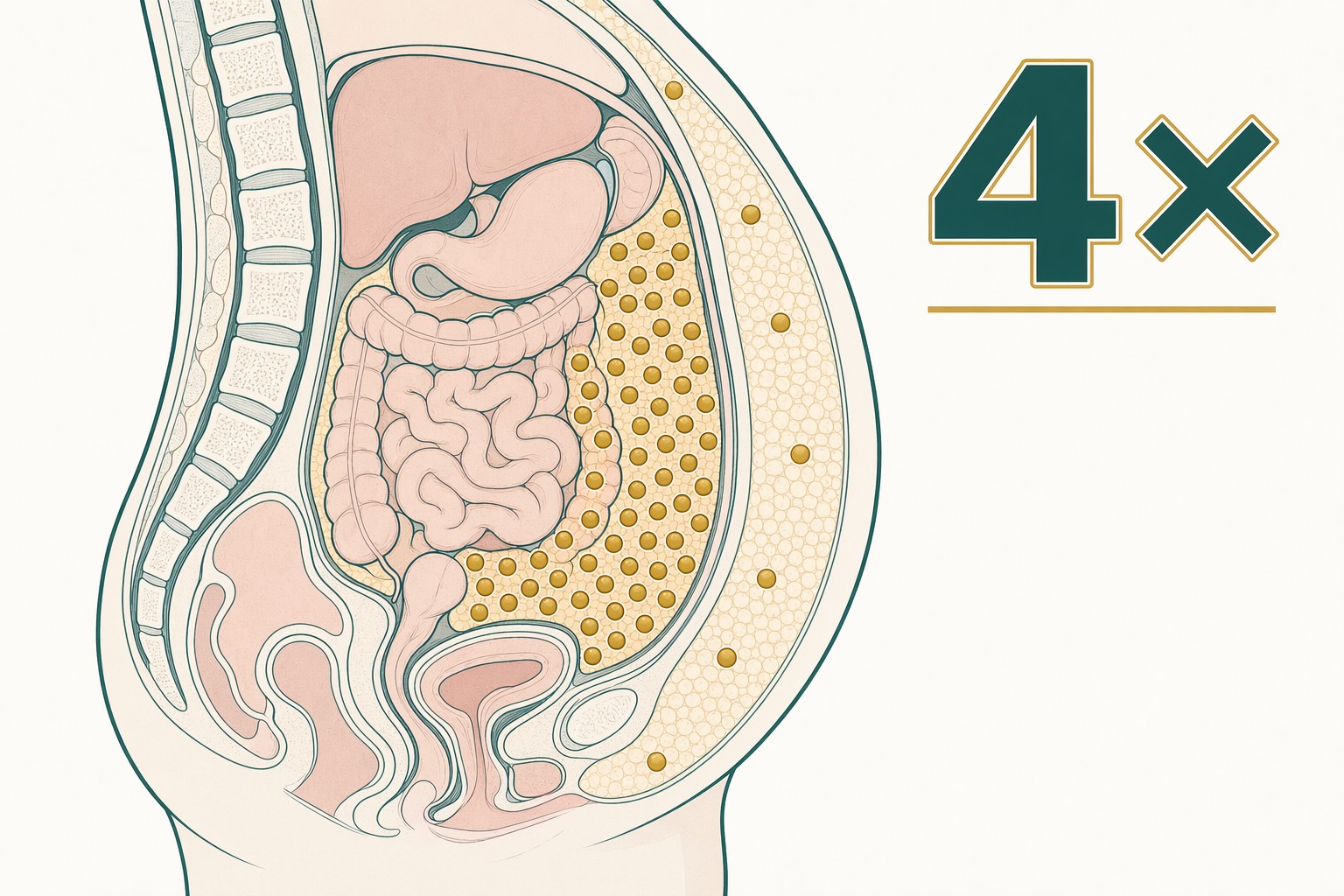
This is not aesthetic. This is endocrinology. Under chronic cortisol, the body preferentially stores fat where the receptors are densest — which is here, specifically, and is why diet changes below your neck can't override a signal coming from above it.
Tired All Day. Wired at 11 p.m.
At 2 p.m. you'd give anything for a 20-minute nap. By 10:30 p.m. you're on the couch and a strange second wind kicks in. You scroll. You reorganize the pantry. You look at furniture you're not going to buy. At 12:15 a.m. you finally get into bed and your brain is racing.
This is sometimes called "tired but wired." Women in their 40s describe it constantly — in forums, in perimenopause groups, in their doctors' offices. It's one of the most common complaints in this demographic and one of the most consistently dismissed.
What the research shows The pattern reflects inverted cortisol rhythm. Cortisol is supposed to be highest in the morning to wake you and lowest at night to let you sleep. In dysregulated perimenopausal cortisol, the curve can flatten or invert — low when you need it high, high when you need it low.
What it means You don't need more caffeine during the day or more wine at night. You need your cortisol rhythm to repair.
Words You Used to Have, Gone
You were making a point in a meeting and lost the word "threshold." You had to say "the limit where it starts to matter" instead and hope no one noticed. You walked into the kitchen and couldn't remember why. You were talking to your mother and said your daughter's name wrong — not a slip of the tongue, a real blank.
You're 46 and you find yourself Googling "early signs of dementia" at midnight. You don't mention this to anyone because it feels like a small thing each time. But it happens weekly.
What the research shows Chronically elevated cortisol has been shown to affect the hippocampus — the brain region responsible for memory consolidation and word retrieval. Imaging studies have found measurable hippocampal volume changes in people with long-term cortisol elevation. In perimenopausal women, declining estrogen removes one of the hippocampus's protective factors, amplifying this effect.
What it means This is almost certainly not early dementia. It is a reversible consequence of cortisol load combined with estrogen decline. When cortisol regulates and estrogen stabilizes, word retrieval and working memory tend to return.
You Cry at Things That Aren't That Sad
It was a Subaru commercial. A dog. A road trip. You were standing at the kitchen counter and tears were running. You have no particular feeling about Subarus. You didn't know the dog. You wiped your face and kept unloading the dishwasher.
Or: your husband asked what was for dinner in a neutral tone and you left the room because you didn't trust your voice. Or: the barista forgot the oat milk and you sat in your car for five minutes before you could drive home.
What the research shows Cortisol depletes tryptophan — the amino acid your body uses to make serotonin. When cortisol is chronically elevated, less tryptophan is available for serotonin synthesis. A cortisol-depleted nervous system reacts bigger to smaller triggers.
What it means This isn't a character flaw. It isn't weakness. It's neurochemistry. When cortisol is addressed, the serotonin substrate becomes available again, and emotional reactivity tends to normalize within weeks.
What's Actually Happening — The Mechanism
Here's the part your doctor probably hasn't walked you through.
For most of your adult life, estrogen was one of the primary modulators of your body's cortisol response. When estrogen was high and stable, cortisol stayed in a healthy range. The morning spike woke you up. The daytime taper brought you down. The nighttime low let you sleep.
In perimenopause — which can begin anywhere from your mid-30s to your late-40s — estrogen begins to fluctuate and then decline. Progesterone, which also has a calming effect on the nervous system, declines alongside it. What's left is cortisol, increasingly unchecked by the hormones that used to hold it in balance.
Research published in multiple peer-reviewed journals, including findings associated with Yale researchers on women's health, has documented a pattern: as estrogen declines, cortisol reactivity increases. Women who had normal cortisol responses at 35 can have measurably altered responses at 45. This shift accounts for — or at minimum significantly contributes to — all five of the signs above.
"Your labs come back 'within normal range.' Your doctor says everything looks fine. You leave the appointment feeling crazy. You're not crazy — the standard test is designed for a body that isn't yours anymore."
Why Your Doctor Likely Missed It
If you asked your primary care provider to test your cortisol, they probably drew blood between 7 and 9 a.m. That's the standard. It's also exactly the wrong time to see what's happening to you.
The perimenopausal cortisol spike — the one associated with 3 a.m. wake-ups, belly fat storage, and mood reactivity — happens between 2 and 4 a.m. By the time your morning labs are drawn, cortisol has already dropped. The test comes back "within normal range."
Clinicians who want to see the pattern need to order a four-point salivary cortisol panel or a DUTCH (dried urine) test — both of which insurance rarely covers and most primary care offices don't run.
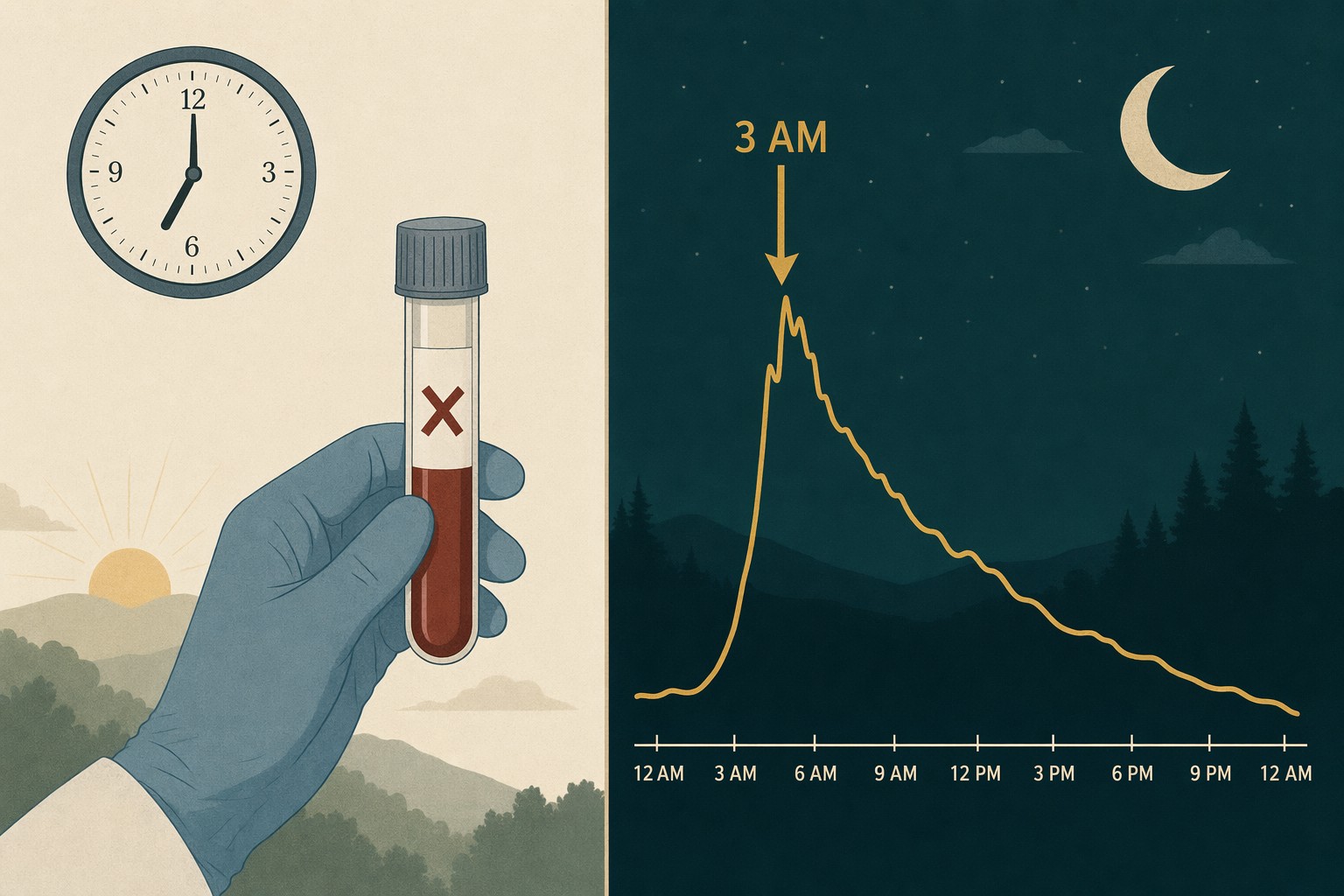
The cortisol peak that wakes you up and reshapes your body happens between 2 and 4 a.m. Your morning blood draw arrives hours after the surge has ended. The result comes back "within normal range." Nothing on the lab slip is wrong — it just isn't looking where the problem lives.
Why HRT, Meditation, and Generic Stress Supplements Often Aren't Enough
You may already have tried one or more of these. They are not useless. They are incomplete.
Hormone Replacement Therapy (HRT) addresses estrogen and sometimes progesterone directly. But HRT does not target cortisol specifically. In women with significant cortisol dysregulation, HRT alone often resolves hot flashes and vaginal dryness but leaves the 3 a.m. wake-ups, the belly weight, and the mood reactivity partially intact.
Meditation and breathwork reduce acute stress response and have real benefits for daytime cortisol. They are less effective at addressing the chronic HPA-axis dysregulation that drives the overnight spike.
Generic stress supplements often hide under-dosed botanicals inside proprietary blends. The issue is not whether an ingredient sounds calming. The issue is whether the form, dose, and supporting nutrients match the biology you are trying to support.
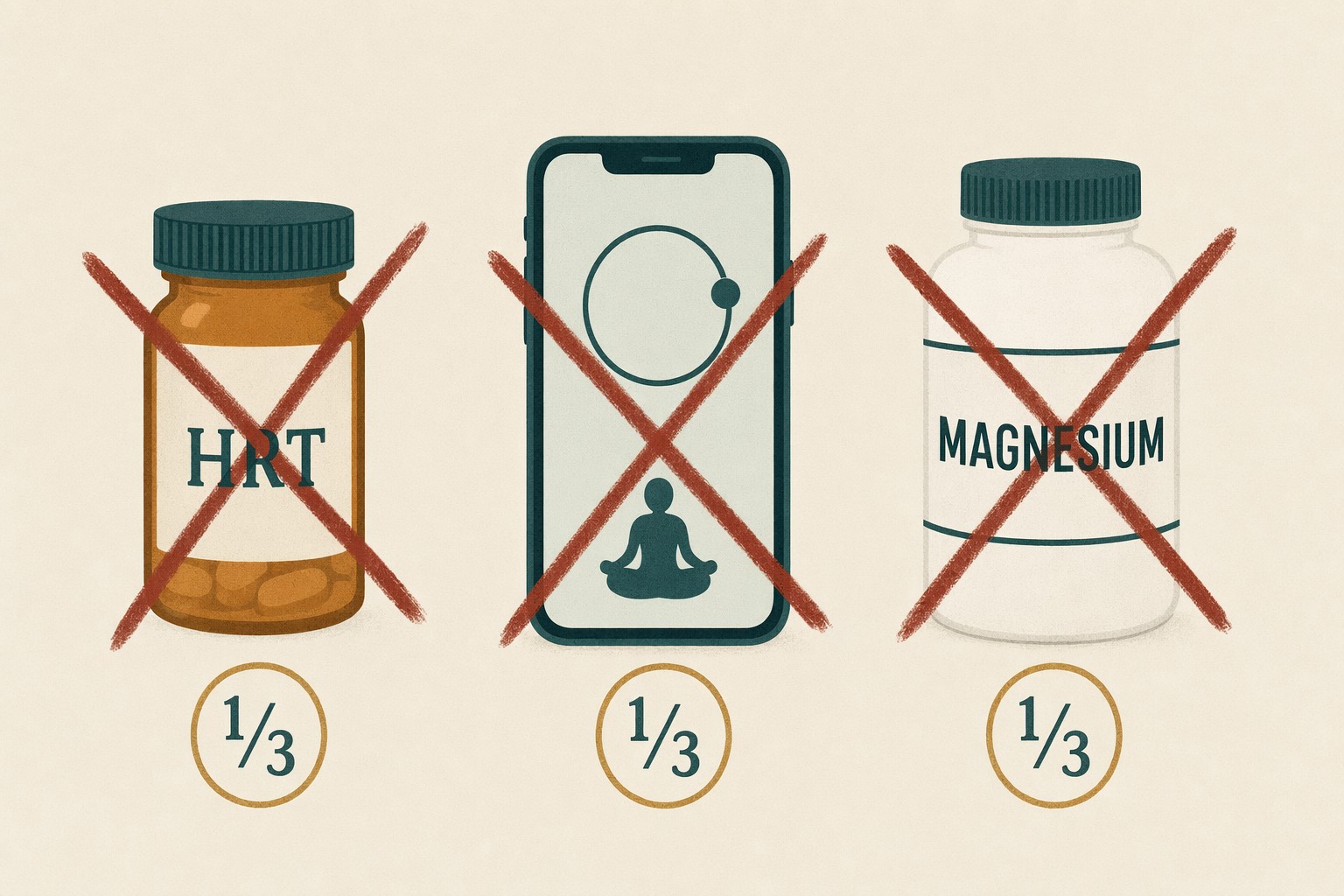
None of these are placebo. HRT can restore estrogen. Meditation can quiet acute stress. Magnesium can support relaxation. But if the core issue is a stress-response pattern that changed after 40, a generic sleep or calm product is often too broad to be useful.
What the research increasingly points to is that the cortisol pattern needs to be supported through the stress-response system itself — using evidence-based adaptogens and nutrient cofactors rather than another single-purpose sleep aid. The best-known adaptogen in that conversation is a specific form of ashwagandha called KSM-66.
Reprieve combines 600 mg KSM-66 ashwagandha with Vitamin D3, B6, B12, L-Arginine, Maca, Panax Ginseng, and Shatavari. The goal is everyday stress-response support, relaxation, energy, circulation, and vitality — not sedation.
KSM-66 — The Ingredient With the Clinical File
There are many forms of ashwagandha on the market. Most of them have weak or absent clinical data. One form has the strongest research base for cortisol specifically: KSM-66 ashwagandha, a patented, full-spectrum root extract standardized to 5% withanolides.
In a 60-day double-blind, placebo-controlled trial published in Medicine (Baltimore) in 2019, adults taking 600 mg of KSM-66 daily showed a 27.9% reduction in serum cortisol compared to placebo, plus significantly lower self-reported stress and improved sleep quality. A separate 2012 trial published in the Indian Journal of Psychological Medicine found similar cortisol reductions in chronically stressed adults over 60 days.
Full 600 mg KSM-66 plus D3, B6, B12, L-Arginine, Maca, Panax Ginseng, and Shatavari. No proprietary blends. 60-day guarantee.
See Reprieve Cortisol Calm →What Women Are Reporting
Slept through the whole night on day 9. I hadn't done that in over a year. My husband actually noticed before I did, he said I looked like I'd had an actual night of sleep.
Sarah M., 47, Denver, CO
The 2 p.m. crash just stopped happening. Then my daughter had a really rough week at school and I actually handled it. Didn't fall apart the way I would have 6 months ago. That's when I realized something had genuinely changed, not just placebo.
Claudia P., 52, Portland, OR
Was honestly pretty skeptical. I've tried 4 other things that did absolutely nothing. But around week 6 the brain fog lifted. I could find my words again in meetings. I stopped apologizing for 'menopause brain' at work, which feels really good to say out loud.
Jennifer R., 49, Austin, TX
Cortisol takes 8 to 12 weeks to recalibrate. This is the full protocol. Return the bottles empty or full for a refund.
Start the 90-Day Reset — $119 →